
Equity Clear calls for capital allocation transparency in Productivity Commission inquiry

In May 2026, the Productivity Commission commenced an inquiry into reducing barriers to business dynamism in Australia. It is examining obstacles to businesses starting, growing, transferring and closing, including access to capital, and how unnecessary barriers can constrain productivity and economic growth. An interim report is due in November 2026, with the final report to Government by May 2027. Productivity Commission
At the heart of Equity Clear’s work is improving visibility into how capital is allocated. Australia still lacks a consistent national view of how businesses move through funding pipelines, where opportunities fall away and whether those patterns differ across founder groups.
On 23 July, Equity Clear lodged its submission, calling for the National Reporting Standards for Investment Pipeline Diversity to form the basis of nationally consistent reporting infrastructure for capital allocation. It is one of 92 initial submissions published by the Commission, alongside organisations including NAB, ASIC, the Australian Institute of Company Directors, the Tech Council of Australia, CEDA, First Australians Capital, UNSW Centre for Social Impact and Vox Femina. A complementary submission from Australians Investing in Women (AIIW) was developed through the Gender Lens Investing Collaborative (GLIC), with Equity Clear contributing as a member of the Collaborative. Productivity Commission
A national approach to capital allocation reporting
Equity Clear calls for the Australian Government to:
recognise the National Reporting Standards for Investment Pipeline Diversity as Australia’s common national reporting framework, and support the establishment of an independent Australian Investing in Women Code Administrator;
adopt the Standards progressively across relevant publicly backed capital programs and incorporate reporting into its roles as investor, funder and limited partner;
work with State and Territory governments to align reporting approaches and encourage broader participation across private capital markets; and
support the governance, secure data infrastructure, participant assistance, analysis and annual reporting required to establish the framework as enduring national economic infrastructure and evaluate future capital mobilisation initiatives.
These reforms would not prescribe investment decisions or impose quotas. They would establish the evidence infrastructure needed to understand how capital is allocated, support more effective public investment and evaluate future interventions against consistent national data.
We can’t change what we can’t measure
Funding outcomes can tell us which businesses ultimately receive capital and how much is invested. They cannot consistently show what happens before the final decision, who enters the pipeline, who progresses and where opportunities fall away.
As we note in the submission:
“Australia lacks the national reporting infrastructure required to understand how capital is allocated across its economy.”
Through Equity Clear’s Show Us the Data initiative, more than 160 organisations contributed to the development of the National Reporting Standards for Investment Pipeline Diversity. Pilot implementation is now underway with leading investors including Blackbird and AirTree, ahead of broader market rollout targeted for 2027.
The UK model
The United Kingdom provides an established implementation model. Following the Alison Rose Review, the UK Government partnered with industry to establish the Investing in Women Code as a voluntary national reporting framework.
Since 2019, the Code has grown from 12 to 337 signatories across banks, venture capital, angel investment, community finance and limited partners. Alongside the Code, the UK has mobilised more than £600 million through the Women Backing Women Fund of Funds and related initiatives.
In 2025, teams with at least one woman founder received 32% of venture capital investment value from Code signatories, compared with 16% across the wider UK venture capital market.
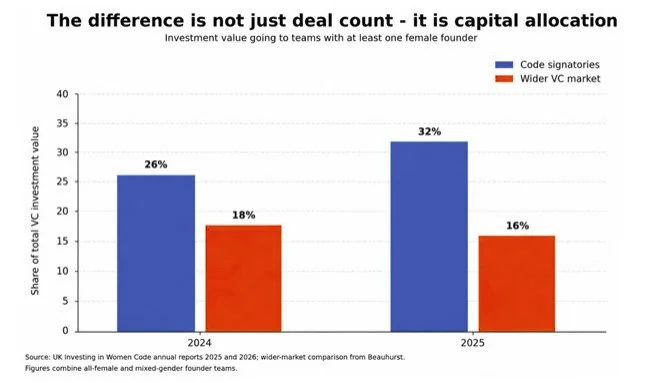
The comparison does not establish that signing the Code caused the difference. What it does demonstrate is that voluntary reporting can operate at scale and create a meaningful benchmark against the wider market. Over six years, that reporting has also moved the evidence beyond final funding outcomes, helping reveal where differences emerge across referral pathways, pipeline progression, follow-on funding and investment committee decisions.
The opportunity for Australia
Australia does not need to start from scratch. Industry has already developed the foundations for nationally consistent reporting, and implementation is underway.
The opportunity now is to establish this work as enduring national infrastructure, giving investors and governments consistent evidence on where barriers arise, whether interventions are working and how capital is being allocated.
As we conclude in the submission:
“The lack of consistent evidence is itself holding back progress.”
Equity Clear’s recommendations complement those in the submission from Australians Investing in Women, developed through the Gender Lens Investing Collaborative. It proposes using existing public finance architecture, including a gender-lens investment stream and fund-of-funds model, to increase the supply of capital to underfunded founders and fund managers.
Together, the two proposals provide the infrastructure needed to understand capital allocation and the mechanisms available to influence it.